

Fertility science makes the case that quitting smoking is not just good for your lungs - it may be the single most impactful thing a man can do to improve IVF success rates.
India has one of the highest rates of tobacco use in the world, with over 267 million adults consuming tobacco in some form – cigarettes, bidi, smokeless tobacco, or gutkha. What is less widely understood is that tobacco use is one of the most significant and yet most reversible causes of male infertility.
For couples going through IVF, the male partner’s tobacco use is not a peripheral lifestyle issue. It is a direct clinical variable that affects fertilisation rates, embryo quality, and ultimately the outcome of treatment.
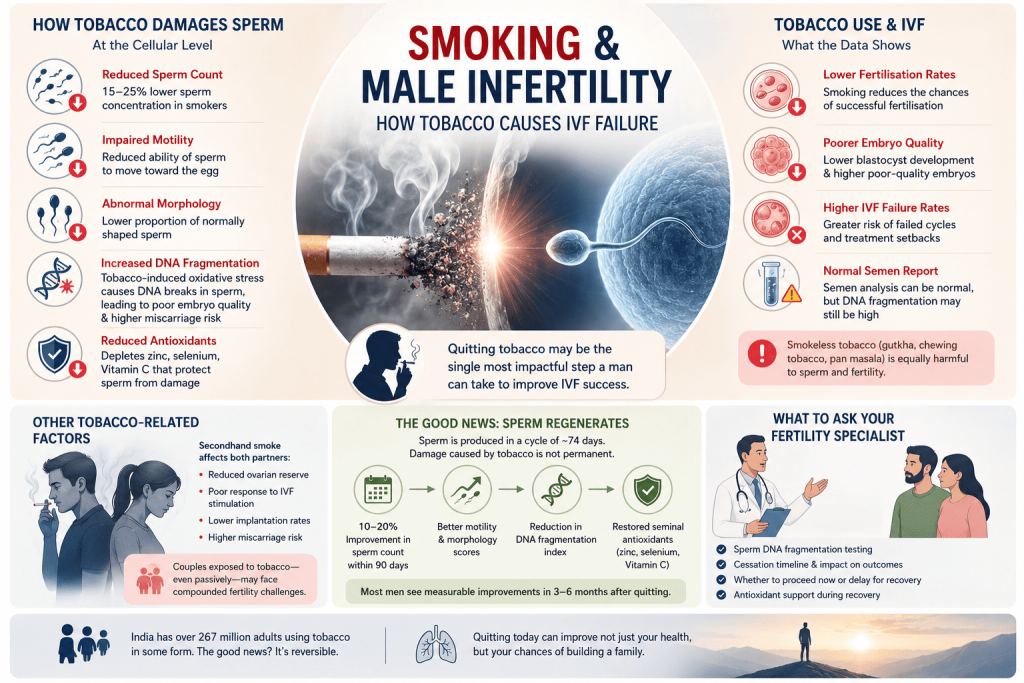
How Tobacco Damages Sperm at the Cellular Level
Tobacco smoke contains over 4,000 chemicals, many of which are classified as reproductive toxins. Their effects on sperm are both well-documented and serious:
- Reduced sperm count: Smokers consistently show 15 to 25 percent lower sperm concentrations compared to non-smokers
- Impaired sperm motility: The ability of sperm to move progressively toward an egg is significantly reduced in men who smoke
- Abnormal sperm morphology: The proportion of normally shaped sperm is lower in tobacco users, reducing the chance of successful fertilisation
- Elevated sperm DNA fragmentation: This is perhaps the most critical effect. Tobacco-induced oxidative stress causes breaks in the DNA contained within sperm. Even if fertilisation occurs, high DNA fragmentation leads to poor embryo development and higher miscarriage rates
- Reduced seminal antioxidants: Tobacco depletes zinc, selenium, and Vitamin C in seminal plasma – nutrients that protect sperm from oxidative damage
Tobacco Use and IVF: What the Data Shows
The impact of male tobacco use on IVF outcomes is measurable at every stage of the process:
Clinical finding: Studies show that couples where the male partner smokes have significantly lower fertilisation rates, lower blastocyst development rates, and higher rates of failed or poor-quality embryos during IVF compared to non-smoking couples.
Importantly, this holds true even when standard semen analysis appears normal. A semen report showing adequate count, motility, and morphology does not rule out high DNA fragmentation – and DNA fragmentation testing is specifically recommended for smokers preparing for IVF.
Smokeless tobacco – chewing tobacco, gutkha, and pan masala – is often perceived as less harmful to fertility than cigarettes. This is a dangerous misconception. Smokeless tobacco produces systemic nicotine absorption at comparable or higher levels than cigarette smoking, with the same downstream effects on sperm quality.
The Good News: Sperm Regenerates
Here is what makes this conversation genuinely hopeful. Unlike eggs, which are fixed at birth and decline with age, sperm is produced continuously in a cycle of approximately 74 days. This means that the damage caused by tobacco is not permanent.
Men who quit smoking and tobacco use typically see measurable improvements in sperm parameters within 3 to 6 months. Studies report:
- 10 to 20 percent improvement in sperm count within 90 days of cessation
- Meaningful recovery in motility and morphology scores
- Reduction in sperm DNA fragmentation index – often the most clinically significant improvement for IVF purposes
- Restoration of seminal antioxidant levels
This means that for a couple planning IVF 3 to 6 months from now, the male partner quitting tobacco today is a clinical intervention – not just a lifestyle suggestion.
Other Tobacco-Related Factors That Affect Fertility
It is worth noting that tobacco affects more than just sperm. For female partners exposed to secondhand smoke, there is evidence of:
- Reduced ovarian reserve
- Poorer response to ovarian stimulation during IVF
- Lower embryo implantation rates
- Higher risk of miscarriage
Couples where both partners are exposed to tobacco – even passively – may therefore have compounded fertility disadvantages that are entirely addressable through cessation.
What to Ask Your Fertility Specialist
If the male partner uses tobacco in any form, the fertility consultation should include:
- Sperm DNA fragmentation testing – not just standard semen analysis
- Discussion of cessation timeline and its projected impact on treatment outcomes
- Assessment of whether proceeding immediately or delaying to allow sperm recovery is the better clinical choice
- Antioxidant supplementation support during the cessation and recovery period
At Nishant IVF and Fertility Centre in Jaipur, male factor evaluation is a core part of every couple’s fertility assessment – not an afterthought. We routinely review tobacco and lifestyle history, conduct comprehensive andrology testing including DNA fragmentation where indicated, and build treatment timelines around achieving the best possible sperm quality before an IVF cycle begins.
Next step: For a male fertility evaluation including sperm DNA fragmentation testing, contact Nishant IVF and Fertility Centre at +91 99502 84285 or visit www.nishantivfcare.com
FAQs
Yes. Smoking reduces sperm count, motility, and morphology, and significantly increases sperm DNA fragmentation – all of which directly affect IVF success.
Sperm parameters typically begin to improve within 90 days and show meaningful recovery at 3 to 6 months after quitting, aligning with one full sperm production cycle.
Smokeless tobacco (gutkha, pan masala) causes comparable or higher systemic nicotine exposure and has the same negative effects on sperm quality as cigarette smoking.
In many cases, yes. Your fertility specialist can advise whether the clinical benefit of improved sperm quality after cessation outweighs the benefit of proceeding immediately.
Disclaimer: This article provides educational information about impact of Tobacco in male fertility and should not replace personalized medical advice. Consult with a qualified fertility specialist for proper evaluation and treatment recommendations specific to your situation.