Millions of women in India have thyroid disorders and do not know it. For couples going through IVF, an unchecked TSH level can silently determine the outcome.
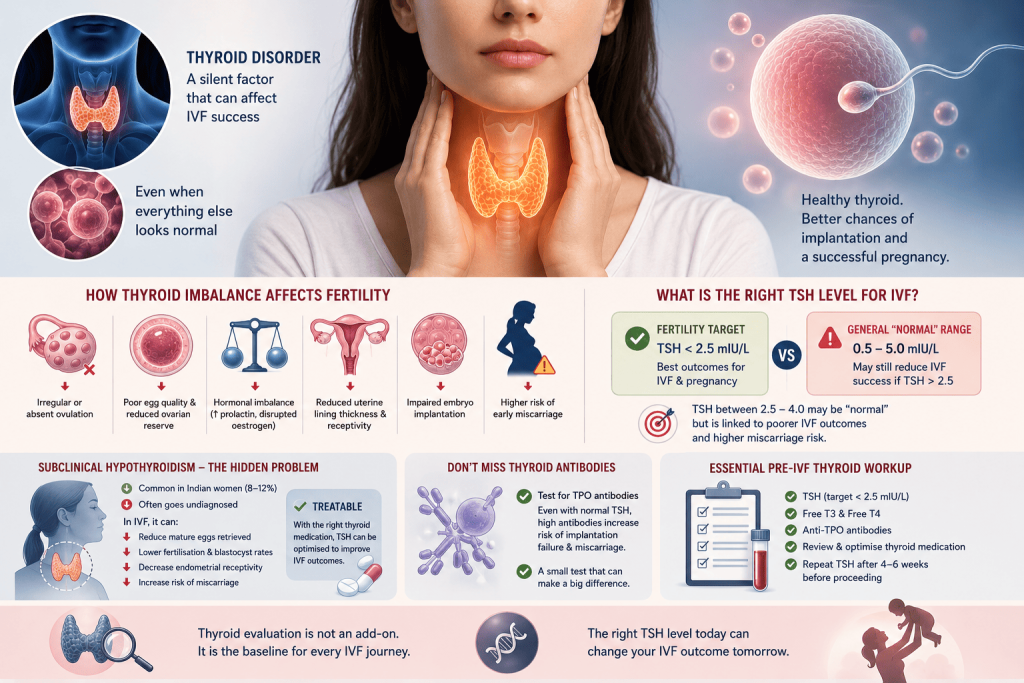
The thyroid gland produces hormones – primarily T3 and T4 – that regulate nearly every metabolic process in the body. When thyroid function is disrupted, the downstream effects on reproductive health are significant and wide-ranging:
- Irregular or absent ovulation
- Poor egg quality and reduced ovarian reserve
- Hormonal imbalance including elevated prolactin and disrupted oestrogen levels
- Reduced thickness and receptivity of the uterine lining
- Impaired embryo implantation
- Higher risk of early miscarriage even after successful transfer
Both hypothyroidism (underactive thyroid) and hyperthyroidism (overactive thyroid) can contribute to infertility, though hypothyroidism is significantly more common in Indian women and tends to be more directly associated with IVF failure.
What Is the Right TSH Level for IVF?
This is one of the most important – and most misunderstood – aspects of fertility care. A TSH level that falls within the general “normal” range of 0.5 to 5.0 mIU/L is routinely reported as acceptable by many labs. However, fertility specialists follow a much stricter standard.
Fertility guideline: For women undergoing IVF or trying to conceive, TSH should ideally be below 2.5 mIU/L. Values between 2.5 and 4.0, while technically “normal,” are associated with significantly poorer IVF outcomes and higher miscarriage rates.
This distinction matters enormously. A woman with a TSH of 3.8 may be told her thyroid is “fine” by a general physician, while a fertility specialist will recognise this as a correctable factor that is likely affecting her chances of success.
Subclinical Hypothyroidism: The Hidden Problem
Subclinical hypothyroidism – where TSH is mildly elevated but T3 and T4 remain normal – is particularly prevalent in North India, including Rajasthan. Studies estimate that subclinical hypothyroidism affects 8 to 12 percent of the Indian female population, with many cases going undiagnosed for years.
In the context of IVF, subclinical hypothyroidism has been shown to:
- Reduce the number of mature eggs retrieved during stimulation
- Lower fertilisation and blastocyst development rates
- Decrease endometrial receptivity
- Increase the probability of first-trimester miscarriage following a positive pregnancy test
The important thing to know: subclinical hypothyroidism is treatable. With appropriate thyroid hormone supplementation – usually low-dose – TSH levels can be brought to the optimal range before and during an IVF cycle, meaningfully improving outcomes.
Thyroid Antibodies: The Often-Missed Test
Beyond TSH, fertility specialists should also check for thyroid peroxidase (TPO) antibodies. A significant proportion of women with autoimmune thyroid disease (Hashimoto’s thyroiditis) have normal TSH levels but elevated antibodies, which independently increase the risk of implantation failure and miscarriage.
What a Thorough Pre-IVF Thyroid Workup Should Include
Beyond TSH, fertility specialists should also check for thyroid peroxidase (TPO) antibodies. A significant proportion of women with autoimmune thyroid disease (Hashimoto’s thyroiditis) have normal TSH levels but elevated antibodies, which independently increase the risk of implantation failure and miscarriage.
Testing for TPO antibodies adds minimal cost but can reveal a significant underlying issue that changes the entire management plan before an IVF cycle begins.
What a Thorough Pre-IVF Thyroid Workup Should Include
- TSH (target below 2.5 mIU/L for fertility purposes)
- Free T3 and Free T4
- Anti-TPO antibodies
- Review of any existing thyroid medication and dose optimisation
- Repeat TSH testing after 4 to 6 weeks of treatment before proceeding
At Nishant IVF and Fertility Centre in Jaipur, thyroid evaluation is part of every initial fertility workup. It is not an add-on or an afterthought – it is the baseline. For patients coming with a history of failed IVF from other centres, an incomplete thyroid evaluation is one of the first things we review, and in a meaningful number of cases, it is exactly where the problem was hiding.
If you are preparing for IVF, have had failed cycles, or are experiencing unexplained infertility, ask your doctor for a complete thyroid panel – not just a TSH – and insist on a fertility-specific interpretation of your results.
Appointment: Contact Nishant IVF and Fertility Centre, Jaipur at +91 99502 84285 or visit www.nishantivfcare.com for a comprehensive pre-IVF thyroid and hormonal evaluation.
FAQs
For IVF, TSH should ideally be below 2.5 mIU/L. Values between 2.5 and 4.0, though technically normal, are associated with poorer outcomes in fertility treatment.
Yes. Even subclinical hypothyroidism – mildly elevated TSH with normal T3/T4 – is associated with lower implantation rates and higher miscarriage risk in IVF.
Yes. TPO antibody testing is recommended, as elevated antibodies independently increase miscarriage risk even with normal TSH levels.
Yes. Correcting TSH to the fertility target range with appropriate thyroid medication before an IVF cycle meaningfully improves implantation and live birth rates.
Disclaimer: This article provides educational information about impact of thyroid in IVF Treatment and should not replace personalized medical advice. Consult with a qualified fertility specialist for proper evaluation and treatment recommendations specific to your situation.