
When a couple achieves pregnancy through IVF after months or years of trying, the journey does not end with a positive beta-hCG result. One of the most important decisions that follows is whether to opt for Non-Invasive Prenatal Testing, more commonly known as NIPT. For many parents, this test raises questions: Is it mandatory? Is it different for IVF pregnancies? What does it actually detect?
This guide answers all of these questions clearly, so you can make an informed decision with confidence.
What is NIPT?
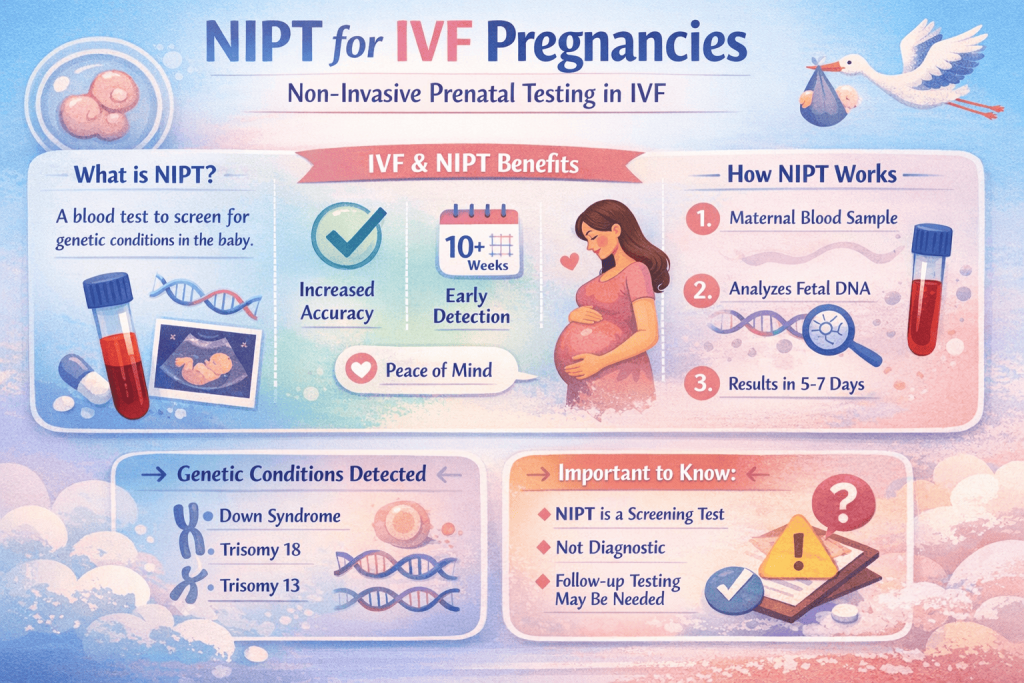
Non-Invasive Prenatal Testing (NIPT) is a blood test performed on the mother that analyzes cellfree fetal DNA circulating in the maternal bloodstream. It is one of the most accurate screening tools available today for detecting chromosomal conditions in a developing baby.
The test is typically performed between 10 and 13 weeks of pregnancy. It is non-invasive, meaning it carries no risk to the fetus, and results are usually available within 7 to 10 days.
What Conditions Does NIPT Screen For?
NIPT primarily screens for the following chromosomal abnormalities:
- Trisomy 21 (Down Syndrome) – caused by an extra copy of chromosome 21
- Trisomy 18 (Edwards Syndrome) – associated with serious developmental issues
- Trisomy 13 (Patau Syndrome) – linked to severe physical and intellectual disabilities
- Sex chromosome abnormalities such as Turner syndrome and Klinefelter syndrome
- Microdeletion syndromes, depending on the panel chosen
It is important to understand that NIPT is a screening test, not a diagnostic test. A positive result
requires confirmation through diagnostic testing such as amniocentesis or chorionic villus sampling (CVS).
Is NIPT Different for IVF Pregnancies?
This is a question many couples who conceive through IVF ask. The short answer is: NIPT is especially relevant for IVF pregnancies, and here is why.
1. Maternal Age Factor
A significant proportion of IVF patients are women over 35. Advanced maternal age is directly associated with a higher risk of chromosomal abnormalities. For women above 35, NIPT is strongly recommended regardless of how conception occurred.
2. Embryo Source and Donor Eggs
In IVF cycles using donor eggs, the genetic risk is based on the donor’s age, not the recipient’s. If the donor is younger, the chromosomal risk may be lower. However, NIPT still provides valuable information about fetal health that ultrasounds alone cannot detect.
3. PGT-A and NIPT: Are Both Needed?
Some IVF patients undergo Preimplantation Genetic Testing for Aneuploidies (PGT-A) before embryo transfer. This test screens embryos for chromosomal abnormalities prior to implantation. Many couples wonder if NIPT is still necessary after PGT-A.
The answer is: NIPT is still recommended even after PGT-A. PGT-A is performed on a few cells from the embryo and is not 100% conclusive. NIPT provides a second layer of validation during the actual pregnancy.
4. Twin Pregnancies
IVF frequently results in twin pregnancies. NIPT in twin gestations is more complex and has slightly lower sensitivity compared to singleton pregnancies, but it remains the safest and least invasive screening option available.
When is NIPT Strongly Advised?
While NIPT is not legally mandated for any pregnancy, fertility specialists recommend it in the following situations:
- Maternal age 35 years or older at the time of delivery
- Previous pregnancy with chromosomal abnormality
- Abnormal findings on first trimester ultrasound such as increased nuchal translucency
- Family history of chromosomal conditions
- IVF pregnancies without prior PGT-A
- Significant anxiety about fetal genetic health
NIPT vs Other Prenatal Screening Tests
Several prenatal screening tests are available, and it helps to understand how NIPT compares:
- Double Marker Test (10-13 weeks): Measures blood markers and nuchal translucency but has lower accuracy than NIPT
- Triple Marker / Quadruple Marker Test (15-20 weeks): Useful but detects fewer conditions
- Anomaly Scan (20 weeks): A detailed ultrasound that identifies structural defects but not chromosomal ones
- NIPT: Highest sensitivity and specificity among non-invasive options NIPT does not replace anomaly scans or genetic counseling. It is best used as part of a comprehensive prenatal care plan.
Is NIPT Safe During IVF Pregnancy?
Yes. Since NIPT involves only a blood draw from the mother, it carries absolutely no risk to the fetus or the pregnancy. This makes it particularly appealing for IVF pregnancies, where couples have often invested significantly in achieving conception and are understandably cautious about any invasive procedure.
Understanding NIPT Results
A low-risk NIPT result is reassuring but not a guarantee. A high-risk result is not a diagnosis. In either case, your fertility specialist or genetic counselor will guide you on the appropriate next steps.
It is important not to make any pregnancy-related decisions based solely on NIPT results without professional consultation.
Expert Insight from Dr. Nishant Dixit
 At Nishant IVF and Fertility Clinic in Jaipur, Dr. Nishant Dixit recommends NIPT in selected cases in some IVF pregnancies based on patients evaluations and tests. The clinic offers comprehensive counseling to help couples understand their results and make empowered decisions.
If you are searching for a trusted IVF specialist near you in Jaipur, the team at Nishant IVF provides end-to-end support from preconception planning through healthy delivery.
Conclusion
NIPT is not a mandatory test, but for IVF pregnancies, it provides a level of genetic insight that no other non-invasive test currently offers. Given the unique factors involved in IVF conception, including maternal age, embryo quality, and the emotional investment of the journey, NIPT is a valuable tool that brings both clarity and peace of mind.
Speak to your fertility specialist about whether NIPT is right for your specific situation before making any decision.
Disclaimer: This article provides educational information about NIPT in IVF pregnancy and should not replace personalized medical advice. Consult with a qualified fertility specialist for proper evaluation and treatment recommendations specific to your situation.