
Starting your first IVF cycle can feel both hopeful and overwhelming at the same time. The medical terminology, the daily injections, the waiting periods, and the emotional intensity can leave many couples with more questions than answers. This guide addresses the most important and frequently searched questions so that you step into this journey feeling informed, prepared, and grounded.
What Exactly is IVF and How Does it Work?
In Vitro Fertilization (IVF) is a process in which eggs are retrieved from the ovaries, fertilized with sperm in a laboratory setting, and the resulting embryo is transferred into the uterus. The term ‘in vitro’ means ‘outside the body,’ which describes where fertilization takes place.
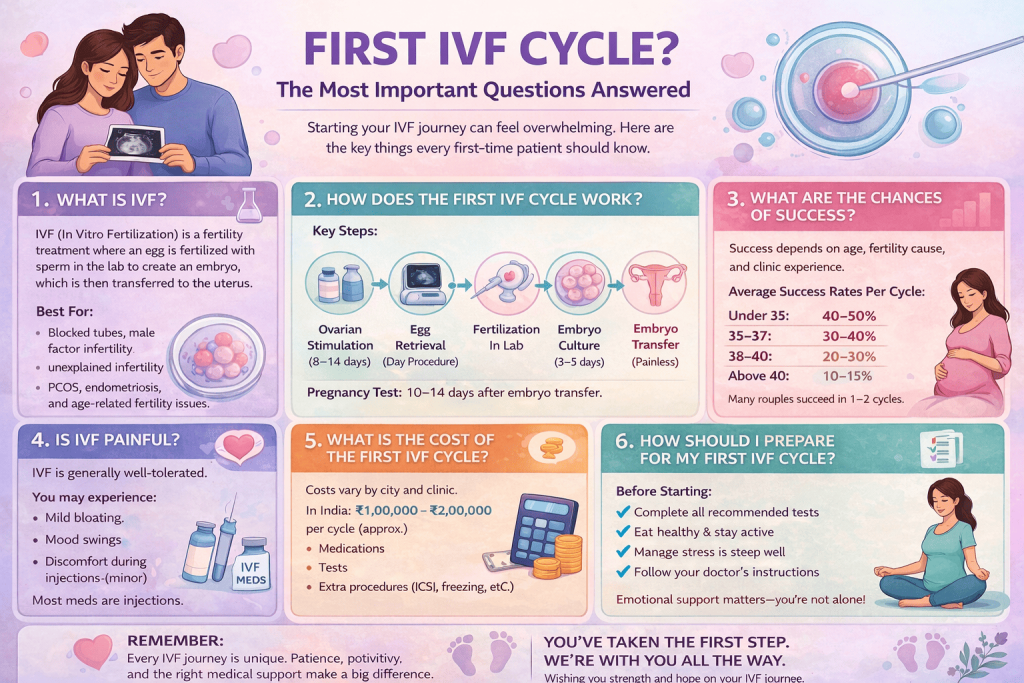
The process involves these key stages:
- Ovarian stimulation: Hormonal injections encourage the ovaries to produce multiple mature eggs
- Egg retrieval: A minor procedure performed under sedation to collect the mature eggs
- Fertilization: Eggs are combined with sperm in the laboratory; ICSI is used if needed
- Embryo culture: Fertilized embryos are monitored for 3 to 5 days in the lab
- Embryo transfer: One or more selected embryos are carefully placed into the uterus
- The two-week wait: A blood pregnancy test is conducted approximately 14 days after transfer
Who is a Good Candidate for IVF?
IVF Treatment is recommended for couples dealing with:
- Blocked or damaged fallopian tubes
- Severe male factor infertility such as very low sperm count or poor motility
- Unexplained infertility after 1 to 2 years of trying naturally
- Ovulation disorders including PCOS
- Endometriosis affecting reproductive function
- Failed intrauterine insemination (IUI) cycles
- Genetic conditions requiring preimplantation genetic testing before transfer
How Long Does One IVF Cycle Take?
A single IVF cycle typically spans 4 to 6 weeks from the start of medication to the pregnancy test. This includes roughly 10 to 14 days of stimulation injections, the egg retrieval procedure, embryo development in the lab over 3 to 5 days, the embryo transfer, and the waiting period before the beta-hCG blood test.
Will IVF Be Painful?
This is one of the most common concerns among first-time IVF patients. The daily hormone injections are subcutaneous (just under the skin) and most patients describe them as a mild sting. Egg retrieval is performed under sedation, so discomfort during the procedure itself is minimal. Some women experience bloating and mild pelvic heaviness due to ovarian stimulation. The embryo transfer is a simple procedure, similar to a routine pelvic examination, and is generally painless.
What Are the Success Rates of IVF?
IVF success rates depend on several factors including the woman’s age, egg and embryo quality, uterine health, and the clinic’s protocols. General statistics from India indicate:
- Women under 35: approximately 40 to 50 percent success rate per cycle
- Women aged 35 to 37: approximately 30 to 40 percent
- Women aged 38 to 40: approximately 20 to 30 percent
- Women above 40: approximately 10 to 20 percent
These are averages and individual outcomes vary based on diagnosis and treatment approach. Advances in embryo freezing and frozen embryo transfers have significantly improved cumulative success rates over multiple cycles.
How Many Embryos Will Be Transferred?
Current best practice in IVF favors single embryo transfer (SET), particularly for younger women with good-quality embryos. Transferring a single embryo reduces the risk of twin and multiple pregnancies, which carry higher health complications for both mother and babies. Your fertility specialist will recommend the best approach based on your specific clinical profile.
What Happens to Extra Embryos?
If more embryos are created than needed for one transfer, healthy surplus embryos can be vitrified (frozen) for future use. Frozen embryo transfer (FET) cycles have high success rates and give couples additional attempts without repeating the full stimulation process, which reduces both cost and physical burden.
What Lifestyle Changes Should I Make During IVF?
While IVF success depends primarily on medical and biological factors, lifestyle choices play a meaningful supporting role:
- Eat a balanced diet rich in antioxidants, lean protein, and healthy fats
- Stop smoking and avoid alcohol completely during the entire cycle
- Reduce caffeine intake to one small cup per day or less
- Prioritize quality sleep and adopt stress-reduction practices such as yoga or meditation
- Avoid intense physical exercise, especially in the days following embryo transfer
- Take all prescribed medications at the exact times instructed by your doctor
Is One IVF Cycle Enough?
Some couples conceive on their very first cycle, while others require multiple attempts. Research consistently shows that cumulative success rates improve significantly over 2 to 3 completed cycles. It is important to approach IVF with realistic expectations and have an open, honest conversation with your specialist about how many cycles may be appropriate for your situation.
What is the Cost of IVF in Jaipur?
IVF costs in India vary depending on the clinic, the medications required, and any additional procedures such as ICSI, PGT, or frozen embryo transfer. At Nishant IVF and Fertility Clinic in Jaipur, Dr. Nishant Dixit ensures complete cost transparency and thorough pre-treatment counseling, so couples are never caught off guard by unexpected expenses.
If you are looking for a trusted IVF clinic near you in Jaipur, the clinic offers individualized treatment plans and compassionate, evidence-based care through every stage of your IVF journey.
How Do I Emotionally Prepare for IVF?
IVF is not just a medical journey; it is a deeply emotional one. The hormonal fluctuations, the uncertainty of waiting for results, and the weight of hope can be significant. Connecting with a counselor, joining a peer support group, and maintaining open communication with your partner are all valuable steps. Many fertility clinics also provide psychological support as an integrated part of their care model.
Guidance from Dr. Nishant Dixit
Dr. Nishant Dixit at Nishant IVF and Fertility Clinic in Jaipur believes that an informed patient is an empowered one. The clinic follows internationally benchmarked, evidence-based protocols tailored to each patient’s unique fertility profile, ensuring the highest possible chances of success while keeping safety and emotional well-being at the center of care.

Conclusion
Your first IVF cycle is one of the most significant steps you will take on your path to parenthood. Understanding the process in detail, setting realistic expectations, and having the right medical team behind you can make all the difference. Never hesitate to ask questions at every stage. The more clearly you understand what is happening, the more confidently you can move through the journey.
Disclaimer: This article provides educational information about common questions asked about IVF and should not replace personalized medical advice. Consult with a qualified fertility specialist for proper evaluation and treatment recommendations specific to your situation.