From a single experimental birth in Oldham in 1978 to over 10 million children worldwide – the story of IVF is one of science meeting human hope. Here is where India stands in that story, and where it is going.
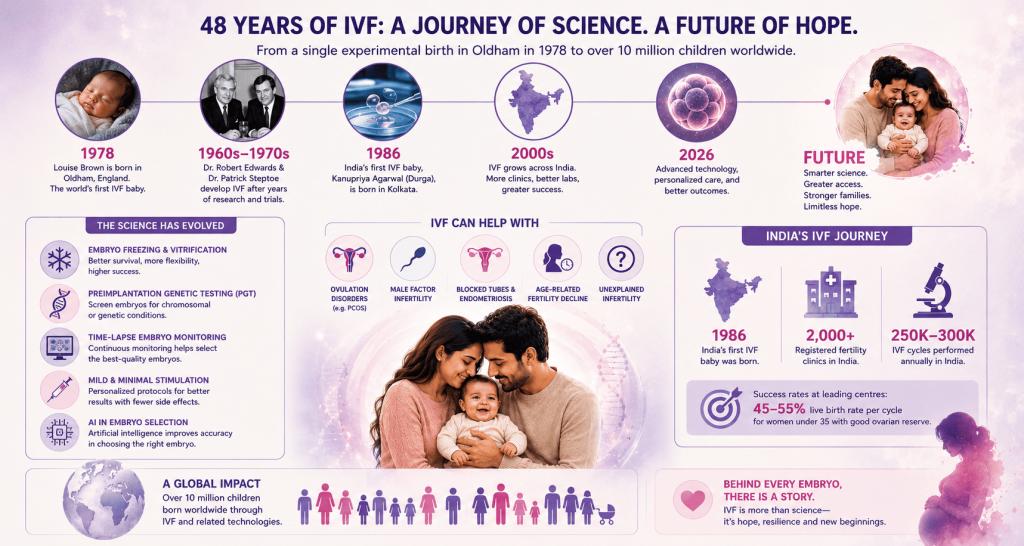
On the night of July 25, 1978, a baby girl named Louise Brown was born in Oldham, England. She was healthy, she was wanted, and she was the product of something the world had never seen before – an embryo fertilised outside a human body and transferred into a waiting womb. Nobody knew then that this single birth would go on to change the lives of tens of millions of people across every continent. Forty-eight years later, on World IVF Day 2026, it is worth pausing to understand not just how far IVF has come globally, but specifically what that progress means for couples in India who are on this journey right now.
The Discovery That Changed Everything
The road to Louise Brown’s birth was not a straight one. Dr. Robert Edwards, a Cambridge embryologist, and Dr. Patrick Steptoe, a gynaecological surgeon, spent over a decade refining the process of stimulating ovaries, retrieving eggs, fertilising them in a controlled laboratory environment, and transferring the resulting embryo. They faced significant scepticism from the medical establishment, rejection from funding bodies, and years of failed attempts before their breakthrough.
What they demonstrated was a principle that seems almost straightforward in retrospect: that human conception did not have to occur inside the body to be biologically valid. An egg fertilised in a laboratory dish, given the right conditions, could develop into a healthy embryo and implant in a prepared uterine lining – producing a healthy child.
Dr. Edwards was awarded the Nobel Prize in Physiology or Medicine in 2010 for this work. Dr. Steptoe had passed away by then, but the recognition reflected what the scientific community had long accepted: this was one of the most consequential medical breakthroughs of the twentieth century.
India's Relationship With IVF: A History Worth Knowing
India’s own IVF story began just eight years after Louise Brown’s birth. In 1986, Kanupriya Agarwal – also known as Durga – became the first IVF baby born in India, in Kolkata. This placed India among the earliest adopters of assisted reproductive technology in Asia, and laid the groundwork for what has since become one of the world’s largest and most active IVF markets.
Today, India performs an estimated 250,000 to 300,000 IVF cycles annually. The country has over 2,000 registered fertility clinics, concentrated in urban centres but increasingly present in Tier 2 cities as well.
Key milestone: India’s IVF success rates at leading centres now match global benchmarks – with live birth rates per cycle reaching 45 to 55 percent for women under 35 with good ovarian reserve.
How the Science Has Evolved: 1978 to 2026
The IVF of 2026 bears only a passing resemblance to the experimental procedure of 1978. The improvements have been cumulative, incremental, and each one has added meaningfully to the probability of a successful pregnancy.
Embryo freezing and vitrification
One of the most transformative advances has been the development of vitrification – ultra-rapid embryo freezing that prevents ice crystal formation and preserves embryo integrity far more effectively than earlier slow-freeze methods. Today, frozen embryo transfer cycles often achieve higher success rates than fresh transfers, because the uterine environment can be prepared independently of ovarian stimulation.
Preimplantation Genetic Testing (PGT)
The ability to biopsy a single cell from a blastocyst embryo and test it for chromosomal abnormalities before transfer has dramatically improved outcomes for older patients, those with recurrent miscarriage, and carriers of hereditary conditions such as thalassaemia. PGT-A screens for aneuploidy; PGT-M targets specific genetic mutations. These tools have made the transfer of a single, chromosomally normal embryo both possible and preferable – reducing twin pregnancies and increasing safety.
Time-lapse embryo monitoring
Modern IVF laboratories now use time-lapse incubation systems that photograph developing embryos every few minutes without disturbing the culture environment. This allows embryologists to assess cell division patterns that correlate with developmental potential – selecting the best-quality embryo without relying solely on a single static assessment.
Mild and minimal stimulation protocols
Early IVF involved aggressive hormonal stimulation that put patients at risk of ovarian hyperstimulation syndrome. Today, individualised stimulation protocols – calibrated to each patient’s AMH, antral follicle count, and previous response – can achieve excellent results with lower doses, reduced side effects, and shorter recovery windows.
Artificial Intelligence in embryo selection
AI-assisted embryo grading is now available at advanced IVF centres. Machine learning models trained on thousands of embryo images can predict blastocyst development and implantation potential with accuracy that matches or exceeds experienced embryologists, reducing the subjectivity that has historically influenced embryo selection.
What World IVF Day Means for Couples Currently on This Journey
For someone in the middle of an IVF cycle – waiting for fertilisation reports, anxious about transfer day, or sitting with the weight of a negative result – the history of the procedure may feel distant. But the reason World IVF Day exists is precisely for those people.
Infertility remains a condition that carries disproportionate emotional weight in Indian society. The stigma – particularly for women – is significant, the financial pressure is real, and the sense of isolation that can come with a diagnosis or a failed cycle is something that public awareness days help to counteract. Every couple that speaks openly about their IVF journey reduces the burden for those who come after them.
Perspective: Globally, IVF and related technologies are estimated to have led to the birth of more than 10 million children. In India, hundreds of thousands of families owe the existence of their children to this science.
At Nishant IVF and Fertility Centre in Jaipur, World IVF Day is an opportunity to reflect on what the science has made possible – and to recommit to providing the most current, personalised, and evidence-based fertility care available. Whether you are just beginning to explore your options or you are in the middle of treatment, you are part of a story that started forty-eight years ago in a hospital room in England, and continues today in clinics across India.
If you have questions about IVF treatment, your fertility options, or what the right next step looks like for your specific situation, reach out. Conversations that begin on World IVF Day have a way of leading somewhere meaningful.
World IVF Day : FAQs
World IVF Day is observed every year on July 25 – the date in 1978 when Louise Brown, the world’s first baby conceived through in vitro fertilisation, was born in Oldham, England. The day commemorates this scientific breakthrough and raises global awareness about infertility and the advances in assisted reproductive technology that have since helped millions of families worldwide.
At leading Indian fertility centres, IVF live birth rates for women under 35 with good ovarian reserve now reach 45 to 55 percent per cycle – broadly comparable to global benchmarks. Success rates decline progressively with age and vary based on diagnosis, embryo quality, and the laboratory and clinical standards of the treating centre.
IVF has advanced substantially across four decades. Key developments include embryo vitrification (ultra-rapid freezing), preimplantation genetic testing (PGT-A and PGT-M), time-lapse embryo monitoring, individualised ovarian stimulation protocols, and AI-assisted embryo selection. Together, these innovations have improved success rates, reduced multiple pregnancy risk, and expanded who IVF can help – including older patients, those with genetic conditions, and people who had previously been considered poor candidates.
India’s first IVF baby, Kanupriya Agarwal – also known as Durga – was born in Kolkata in 1986, just eight years after Louise Brown’s birth in England. This placed India among the earliest Asian adopters of assisted reproductive technology. The country now performs an estimated 250,000 to 300,000 IVF cycles annually.
IVF is typically recommended for couples with blocked or absent fallopian tubes, severe male factor infertility, endometriosis affecting fertility, unexplained infertility after 12 months of trying, recurrent miscarriage with suspected embryo quality issues, or age-related fertility decline. It is also an option for fertility preservation, single parents by choice, and same-sex couples using donor gametes.
Disclaimer: This article provides educational information about IVF evolution journey and should not replace personalized medical advice. Consult with a qualified fertility specialist for proper evaluation and treatment recommendations specific to your situation.